One signal.
The whole vehicle answers.
Flick the turn signal and the left whip goes amber, the left rock lights sweep with it, the left pod rings follow — while every zone you left out keeps running the pattern you chose. If your vehicle can send the signal, RhinoLink can give it a job.
BETA pre-order — first production units are preparing to ship.
How a trigger works
Eight decisions in the app. After that it runs on the vehicle, with or without your phone.
The wire is generic. The meaning is software.
Input 4 is not “the brake input” until you tell the app that is what it is. Change your mind next weekend and the same wire becomes the door input instead — a different job, a different zone, no harness surgery. That is the difference between mapping a signal and hard-wiring one.
What counts as a signal
RhinoLink reads switched 12 V signals — the kind a turn, brake, reverse, courtesy or accessory circuit already provides. Not every circuit on every machine is a clean switched source, so check what you are tapping before you tap it.
The signal arrives
A supported 12 V vehicle signal lands on one of RhinoLink's 12 inputs. Turn, brake, reverse, door, a rocker on the dash — whatever you wired to it.
Choose the RGB action
Pick what the lighting should do when that signal goes live. There are 21 trigger actions to choose from, and the app lists every one of them as you configure.
Choose the zones
Select which of your 5 zones the action touches. Left side only, rear only, all of them. Everything you leave out carries on as it was.
Attach outputs
Optional. Point the same trigger at any of the 8 relay outputs, so one signal moves the lighting and switches hardware together.
Set the priority
A number from 5 to 150 that decides who wins when two vehicle functions want the same zone at the same moment.
Set the debounce
0–1000 ms per input. Long enough to ignore the electrical chatter of a bouncing contact, short enough to keep the real signal instant.
It saves to the board
About 5 seconds after your last edit the configuration is written to the controller — and force-saved if you disconnect before that.
Watch it live
Move the actual lever and the tile lights up in the RhinoLED HUD. The board pushes the state as it changes; the app is not polling for it.
Builds you can configure
None of these are factory defaults. Each one is a trigger you set up — your input, your action, your zones. The zone names below are the ones you type into the app.
Turn signal build
Reverse build
Door and puddle build
Switch panel build
Accessory and RGB, combined
The lights these builds run
A pod's RGB ring is part of the RGB system and can join a zone. A pod's high-output main beam is not an addressable zone — it is switched through an appropriately wired external relay off a RhinoLink output.
When two functions want the same zone
Reverse and a running pattern can both want the Rock Lights. RhinoLink decides which one gets the zone, instead of letting two commands fight over it.
These are floors, not ceilings
Each action starts at the number above. You can raise it anywhere in the 5–150 range when your build wants a different order.
Reverse holds the top floor
Backing up is the moment you most need the zone to do one predictable thing, so reverse starts at 100 — above turn, brake and everything decorative.
Only the contested zone changes
Priority is settled per zone. A brake trigger winning the rear zones does not disturb a whip zone nobody asked for.
Interrupt a zone. Don't break the whole show.
A trigger borrows a zone; it does not reset your build. While the trigger is active that zone does the trigger's job. When it releases, RhinoLink puts the zone back.
What comes back
- The zone's pattern, colors, brightness and speed return.
- If another zone is still running that same animated pattern, the returning zone re-joins that live animation.
- With no matching peer still running it, an animation may start again from the beginning.
- A solid color restores directly.
This is trigger restore, and it is a different feature from a Startup Profile. A Startup Profile decides how the vehicle wakes up at power-on. Trigger restore is what happens the instant a brake pedal or a turn lever lets go.
The action catalogue
21 trigger actions, plus a relay-only mode. You do not have to memorise them — the app lists the set when you configure a trigger. This is the shape of it.
Automotive
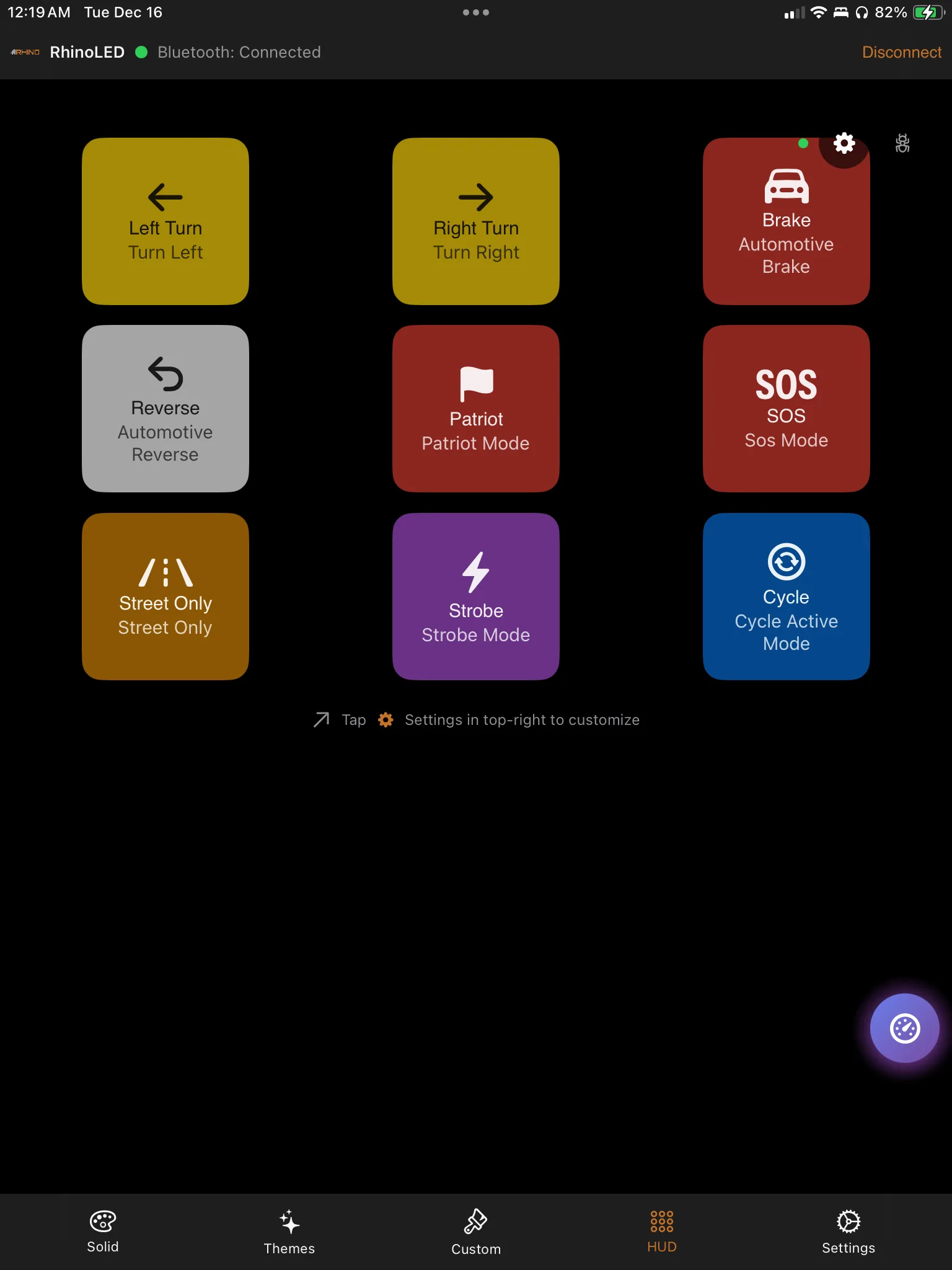
Left turn / right turn
Amber signalling across the zones you chose
Brake
Takes the rear zones the moment the pedal goes down
Reverse
The highest priority floor on the board
Hazard
Shares the turn floor, both sides at once
Street Only
A driving-oriented base mode that sits above the decorative patterns and below turn, brake and reverse
Scene and signal
Pattern and color actions
Send the selected zones to a chosen look
Strobe
A high-contrast attention pattern on demand
SOS
Sits above the standard actions, below the driving functions
Patriot
Its own floor in the ladder above
Cycle active mode
Steps the active mode on from a single button
Outputs
No LED Action — relay only
A trigger that fires outputs and leaves every zone alone. It is a mode on a trigger, not an extra action in the list
Solid
Output held on while the trigger is active
Pulse
Rate configurable from 0.5 to 10 Hz
Strobe
Same configurable 0.5–10 Hz range, faster end of it
Work lights, bar, fan, compressor, backup pods
That is what the 8 outputs are for — hardware that turns on because the vehicle did something. Wire the accessory through its own relay and let RhinoLink switch the coil.
The outputs trigger external relay coils. They do not power a high-current accessory directly — always put an appropriately rated relay between RhinoLink and the load.
Configured once. Then it runs on the vehicle.
Every trigger you set up is written to the controller — about 5 seconds after your last edit, and force-saved if you disconnect first. From then on the vehicle functions do not wait on your phone. Hit the brake with the phone in your pocket, in the truck, or flat on the charger: the zones respond, because the logic is on the board. The rest of what the controller does — zones, patterns, themes, how the vehicle wakes up — is on the RhinoLink overview.
What the app is for
RhinoLED builds the system: triggers, zones, actions, priorities, output labels — plus interactive control when you want to drive the lighting by hand. iPhone, iOS 15.0 or later, free download.
The link stays part of it
Bluetooth Low Energy is how you reach the controller to change anything and how the HUD watches it live. Name the board whatever you like, up to 31 characters.
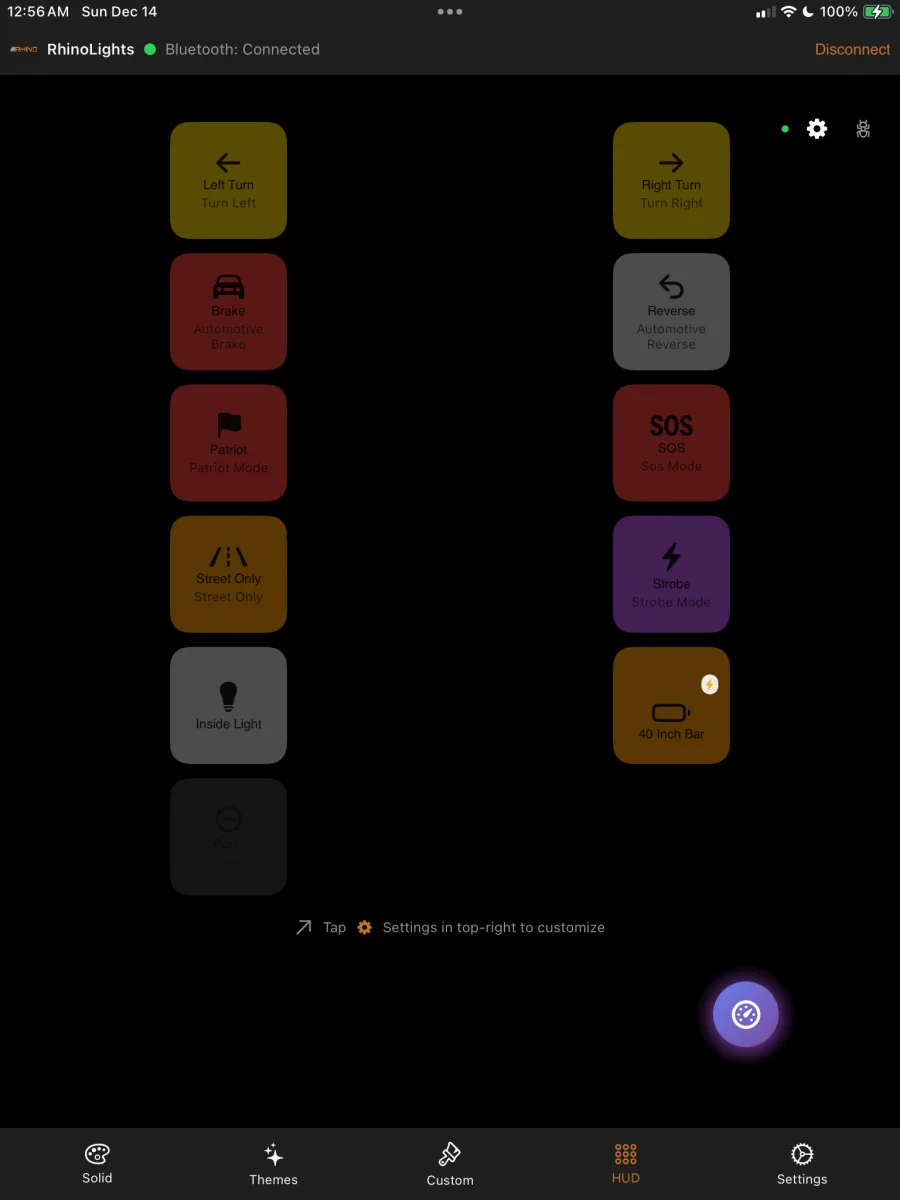
Name the tiles and the HUD reads like your build — “Inside Light”, “40 Inch Bar” — instead of channel numbers. The board pushes state as it changes, so the tile you are looking at is the one the vehicle is running.
Give one wire a new job.
BETA pre-order — first production units are preparing to ship.
RhinoLink controls auxiliary and accent lighting. It is not a replacement for required factory vehicle lighting. Lighting regulations vary — check local requirements before public-road use.